Enventory Retrospective
Updated Fri 2025-10-10 | 1589 words
I've had a lot of fun writing enventory, and here on some notes of what I've learned (mostly about architecture and Go)! I'm writing this post as an alternative to slides for a talk to give a few friends.
Project
What is enventory?
From the README
Centrally manage environment variables with SQLite
- Automatically export/unexport environments when entering/leaving directories
- Keep a global view of which variables apply to which projects (as well as date created/updated, optional comments).
- Filter environments to keep your view manageable:
enventory env list --expr 'filter(Envs, hasPrefix(.Name, "test") and .UpdateTime > now() - duration("90d"))'
- Share variables between environments with variable references
- Advanced tab completion! Autocomplete commands, flags, env names, var/ref names
- Currently only supports
zsh
Demo
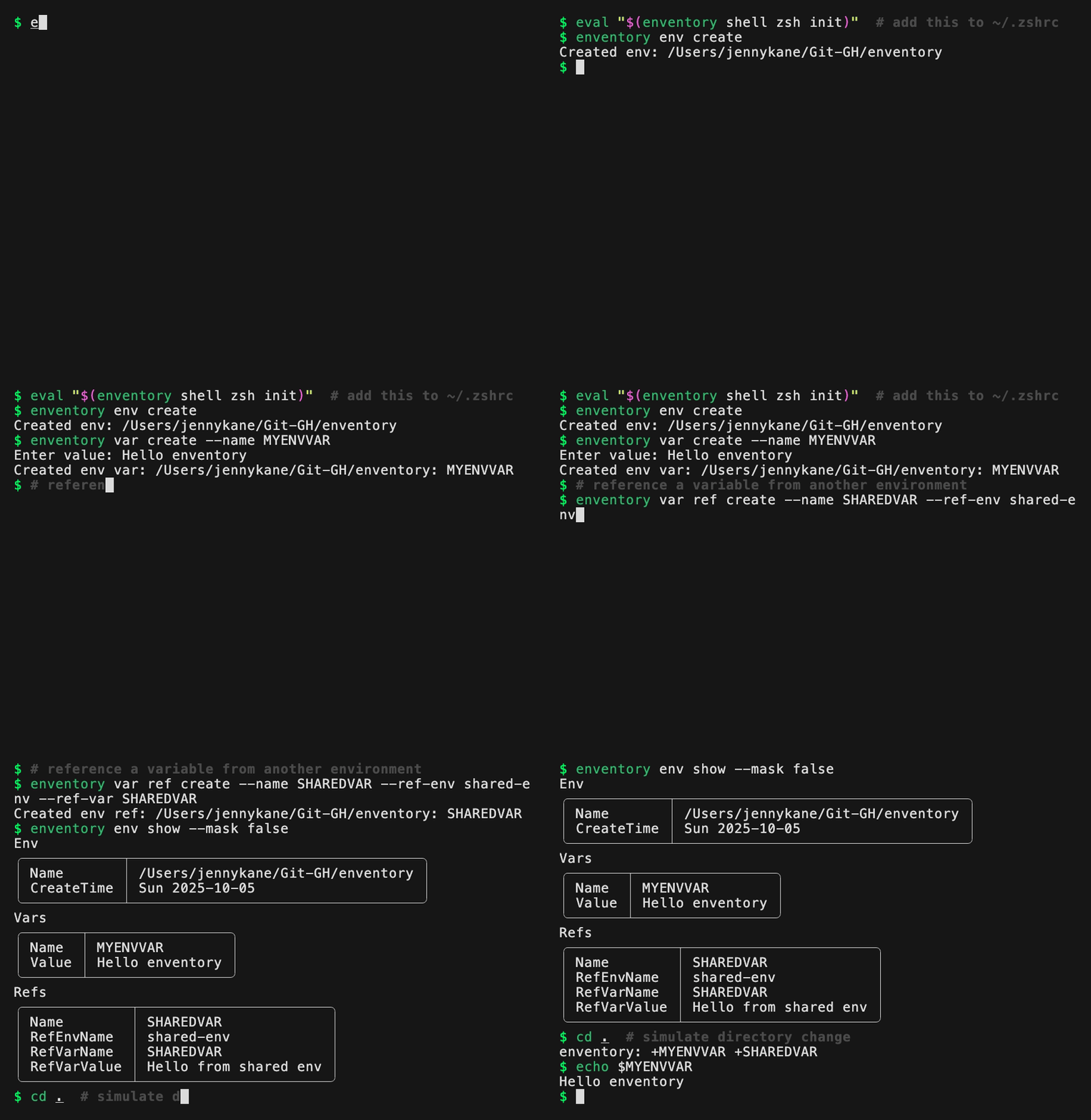
Motivation
-
Solve a small problem I have
-
Learning
- I've never been happy with CRUD architures in work projects
- Take my time writing, learning, and rewriting my own CRUD architecture
-
Fun! (and exercise my CLI library)
Lines Of Code
~4500 lines of Go code to drive ~350 lines of SQL
$ tokei --compact
===============================================================================
 Language            Files        Lines         Code     Comments       Blanks
===============================================================================
 Go                     32         5426         4577          168          681
 JSON                    1            1            1            0            0
 Markdown               12          707            0          455          252
 SQL                     9          458          349           41           68
 SVG                     8          711          658           53            0
 Plain Text            160          285            0          285            0
 YAML                    3           39           32            6            1
 Zsh                     2           95           64           13           18
===============================================================================
 Total                 227         7722         5681         1021         1020
===============================================================================
Project Length
~360 commits over 1.75 years

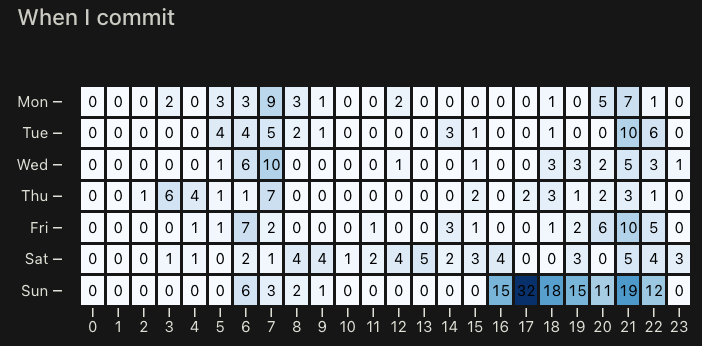
Active hours per week
Side project schedule: mornings, evenings, weekends
Most commits around 5PM Sundays 🤷♂️
Architecture
A "layered architecture" inspired by the WTF Dial blog posts
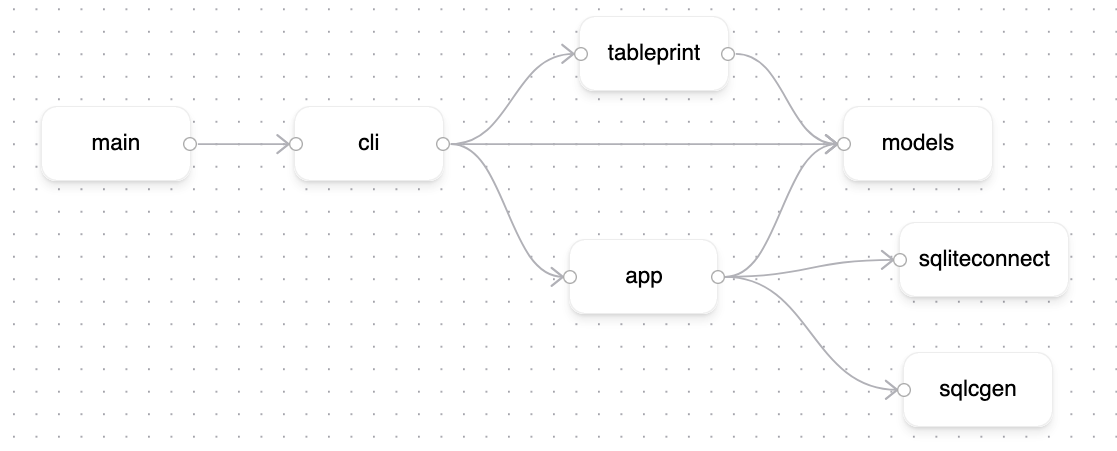
This is viewable in the import graph:
- Top level "presentation" layer -
clipackage - Business layer in the middle -
apppackage - Generate DB layer with sqlc -
sqlcgenpackage cliandapppackages share types via amodelspackage
Layered Architecture Thoughts
Advantages:
- Easy to add/enforce things within a layer (i.e., adding observability to a layer is as simple as wrapping the layer's interface with one that logged the method and called the layer )
- It's generally pretty easy to know where to put things (sometimes hard between CLI and business layer)
Disadvantages
- Lots of translating between the layers
- Adding a feature means updating all the layers
- Layers can get thick with lots of methods
Other:
- I tried to break up my interfaces (
Service,Queries) into smaller ones , but all my things refer to each other so I didn't find a good place
CLI Design
Design Notes
- Make CLIs you'll actually use. You'll quickly discover what features they need
- Read a few CLI design guides and pick a favorite (like this (REALLY good Cobra talk) or this or this)
- I picked the "subcommand subcommand verb flags" way inspired by
azure-cli
- I picked the "subcommand subcommand verb flags" way inspired by
- Iterate on your app's CLI design (any subcommands, flags, etc) in a text file before coding it up to make sure everything is nicely organized

- 6 sections (used to group commands)
- 19 commands total (so far)
Tab Completion
CLI commands that are painfully long to type
enventory var ref create \
    --env /path/to/project \
    --name example_com_API_KEY \
    --ref-env example_com_env \
    --ref-var example_com_API_KEY
Most of these can be tab completed!
Added REALLY GOOD tab completion to autocomplete basically anything already in the database (i.e., --env, --ref-env, --ref-var), scoped by previous passed flags. Example: limits --ref-var suggestions to variables that exist in --ref-env.
Readable Output
I use "Key/value" tables (quite similar to MySQL's "vertical output" mode )
$ go run . env list
╭────────────┬───────────────────────────────────────╮
│ Name       │ /Users/jennykane/Apps/openobserve-... │
│ CreateTime │ Fri 2025-08-22                        │
├────────────┼───────────────────────────────────────┤
│ Name       │ /Users/jennykane/Git-GH/enventory     │
│ CreateTime │ Mon 2024-06-24                        │
│ UpdateTime │ Tue 2025-08-26                        │
├────────────┼───────────────────────────────────────┤
│ Name       │ /Users/jennykane/Git-GH/git-xargs-... │
│ CreateTime │ Tue 2025-05-13                        │
├────────────┼───────────────────────────────────────┤
│ Name       │ /Users/jennykane/Git-GH/shovel_ans... │
│ CreateTime │ Sat 2024-05-04                        │
├────────────┼───────────────────────────────────────┤
│ Name       │ openobserve                           │
│ CreateTime │ Fri 2025-08-22                        │
├────────────┼───────────────────────────────────────┤
│ Name       │ otel_otlp_local_openobserve           │
│ CreateTime │ Fri 2025-10-10                        │
╰────────────┴───────────────────────────────────────╯- Balance readability with information density
- Value truncation if screen width is too small
- Don't show "uninteresting" key/value pairs (omit
UpdateTimeif it's the same asCreateTime)
Filter/sort env list with expr query language
Find the environments I care about
$ enventory env list \
    --expr 'filter(Envs, not pathExists(.Name) or .UpdateTime > now() - duration("90d"))'
╭────────────┬────────────────────────────────────────────────────────────╮
│ Name       │ /Users/jennykane/Apps/openobserve-v0.15.0-rc5-darwin-arm64 │
│ CreateTime │ Fri 2025-08-22                                             │
├────────────┼────────────────────────────────────────────────────────────┤
│ Name       │ /Users/jennykane/Git-GH/enventory                          │
│ CreateTime │ Mon 2024-06-24                                             │
│ UpdateTime │ Tue 2025-08-26                                             │
├────────────┼────────────────────────────────────────────────────────────┤
│ Name       │ openobserve                                                │
│ CreateTime │ Fri 2025-08-22                                             │
├────────────┼────────────────────────────────────────────────────────────┤
│ Name       │ otel_otlp_local_openobserve                                │
│ CreateTime │ Fri 2025-10-10                                             │
╰────────────┴────────────────────────────────────────────────────────────╯
CLI Implementation
Command Nesting
Command nesting is pretty declarative:
app := warg.New(
  "enventory",
  version,
  warg.NewSection(
    "Manage Environmental secrets centrally",
    warg.NewSubSection(
      "completion",
      "Print completion scripts",
      warg.SubCmd("zsh", cli.CompletionZshCmd()),
    ),
    warg.NewSubSection(
      "env",
      "Environment commands",
      warg.SubCmd("create", cli.EnvCreateCmd()),
      warg.SubCmd("delete", cli.EnvDeleteCmd()),
      warg.SubCmd("list", cli.EnvListCmd()),
      warg.SubCmd("update", cli.EnvUpdateCmd()),
      warg.SubCmd("show", cli.EnvShowCmd()),
    ),
    // more sections / commands
Setting up a Command
Setting up a command is also not bad (using helper functions as some of these flags are re-used)
func EnvDeleteCmd() warg.Cmd {
  return warg.NewCmd(
    "Delete an environment and associated vars",
    withConfirm(withSetup(envDelete)),
    warg.CmdFlag("--name", envNameFlag()),
    warg.CmdFlagMap(confirmFlag()),
    warg.CmdFlagMap(timeoutFlagMap()),
    warg.CmdFlagMap(sqliteDSNFlagMap()),
  )
}
Running a Command
Piping the parsed flags into the business layer is a bit annoying, as is dealing with errors:
func envDelete(ctx context.Context, es models.Service, cmdCtx warg.CmdContext) error {
  name := mustGetNameArg(cmdCtx.Flags)
  err := es.WithTx(ctx, func(ctx context.Context, es models.Service) error {
    err := es.EnvDelete(ctx, name)
    if err != nil {
      return fmt.Errorf("could not delete env: %s: %w", name, err)
    }
    return nil
  })
  if err != nil {
    return err
  }

  fmt.Fprintf(cmdCtx.Stdout, "deleted: %s\n", name)
  return nil
}
Command Decorator Pattern
Use decorators like withSetup or withConfirm to reduce verbosity:
// withConfirm wraps a cli.Action to ask for confirmation before running
func withConfirm(f func(cmdCtx warg.CmdContext) error) warg.Action {
  return func(cmdCtx warg.CmdContext) error {
    confirm := cmdCtx.Flags["--confirm"].(bool)
    if !confirm {
      return f(cmdCtx)
    }

    fmt.Print("Type 'yes' to continue: ")
    reader := bufio.NewReader(os.Stdin)
    confirmation, err := reader.ReadString('\n')
    if err != nil {
      return fmt.Errorf("confirmation ReadString error: %w", err)
    }
    confirmation = strings.TrimSpace(confirmation)
    if confirmation != "yes" {
      return fmt.Errorf("unconfirmed change")
    }
    return f(cmdCtx)
  }
}
CLI Snapshot Testing
Allow deterministic output with either flags or a special app setup, so you can easily write snapshot tests.
enventoryhas a--create-timeflag that defaults to the current time but can be passed a date so the output is deterministic.shovel(another app I wrote) allows the app to be constructed with an injectable I/O function. Tests use a mock function,main()uses a real one
Enventory is small and self-contained enough that snapshot tests are fast and convenient!
- Why test one layer when you can test them all at once?
- Each test makes its own SQLite DB
- Tests are run in parallel (enforced by
paralleltest)
CLI Test Example
- Most tests are a sequence of enventory commands with a small "Builder" DSL to get easy tab completion
tests := []testcase{
  {
    name:            "01_envCreate",
    args:            envCreateTestCmd(dbName, envName01),
    expectActionErr: false,
  },
  {
    name: "02_envShow",
    args: new(testCmdBuilder).Strs("env", "show").
      Name(envName01).Tz().Mask(false).Finish(dbName),
    expectActionErr: false,
  },
  {
    name: "03_envList",
    args: new(testCmdBuilder).Strs("env", "list").
      Strs("--timezone", "utc").Finish(dbName),
    expectActionErr: false,
  },
}
stderr and stdout are compared against files and and the test fails if the output doesn't match.
Example file content:
╭────────────┬────────────────╮
│ Name       │ envName01      │
│ CreateTime │ Mon 0001-01-01 │
╰────────────┴────────────────╯
App Layer
Service interface
Implements interface from models package, handles transactions to database layer.
I couldn't figure out a meaningful way to isolate functionality, so it's one big interface...
type Service interface {
  EnvCreate(ctx context.Context, args EnvCreateArgs) (*Env, error)
  EnvDelete(ctx context.Context, name string) error
  EnvList(ctx context.Context, args EnvListArgs) ([]Env, error)
  EnvUpdate(ctx context.Context, name string, args EnvUpdateArgs) error
  EnvShow(ctx context.Context, name string) (*Env, error)

  VarCreate(ctx context.Context, args VarCreateArgs) (*Var, error)
  VarDelete(ctx context.Context, envName string, name string) error
  VarList(ctx context.Context, envName string) ([]Var, error)
  VarUpdate(ctx context.Context, envName string, name string, args VarUpdateArgs) error
  VarShow(ctx context.Context, envName string, name string) (*Var, []VarRef, error)

  VarRefCreate(ctx context.Context, args VarRefCreateArgs) (*VarRef, error)
  VarRefDelete(ctx context.Context, envName string, name string) error
  VarRefList(ctx context.Context, envName string) ([]VarRef, []Var, error)
  VarRefShow(ctx context.Context, envName string, name string) (*VarRef, *Var, error)
  VarRefUpdate(ctx context.Context, envName string, name string, args VarRefUpdateArgs) error

  WithTx(ctx context.Context, fn func(ctx context.Context, es Service) error) error
}
Transactions
Allows callers to run arbitrary code in the callback fn. It's best to keep transactions at the top level, since they can't be nested
WithTx(ctx context.Context, fn func(ctx context.Context, es Service) error) errorInspiration: Transactions in Go Hexagonal Architecture | by Khaled Karam | The Qonto Way | Medium
Usage:
err := es.WithTx(ctx, func(ctx context.Context, es models.Service) error {
  var err error
  env, err = es.EnvCreate(ctx, createArgs)
  if err != nil {
    return err
  }
  return nil
})
if err != nil {
  return fmt.Errorf("could not create env: %w", err)
}
DB Layer
- Shove data into the database
- Where to write and validate?
- App layer does all writes
- DB layer rejects writes that that violate constraints
- Migrate with SQL files
- Generate Go -> SQL functions with sqlc.dev
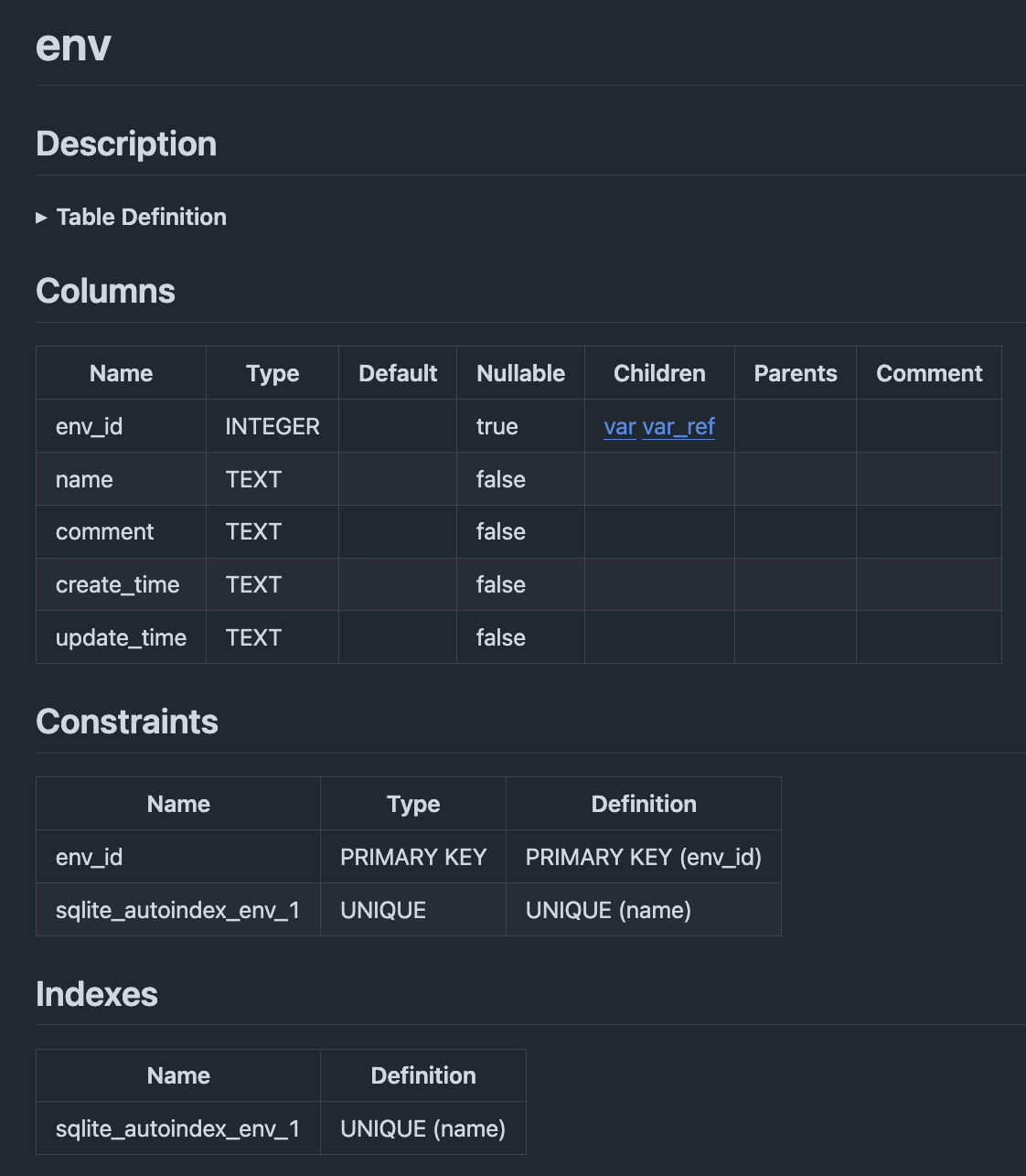
- Generate markdown docs with k1LoW/tbls: tbls is a CI-Friendly tool to document a database, written in Go.
Main Tables

- All tables have
comment,create_time,update_time - Tables use
<tablename>_idinteger primary keys- Makes renames easy
Cross-table UNIQUE Constraints
vars and var refs are in different tables, yet must have unique names in the environment so exports work correctly.
Use views + triggers!
- Create a view with all the names in the env
- Use triggers to FAIL the insert/update if we can find the name in the view
CREATE TRIGGER tr_var_insert_check_unique_name
BEFORE INSERT ON var
FOR EACH ROW
  BEGIN
    SELECT RAISE(FAIL, 'name already exists in env')
  FROM
    vw_env_var_var_ref_unique_name
  WHERE env_id = NEW.env_id AND name = NEW.name;
END
Thoughts
- I like that this is the "bottom layer" - upper layers don't need to validate this
- SQL is hard to write (limited autocomplete), debug, and test
SQL Migrations
- Plain SQL files - alter table, add tables, update views, etc.
- Embedded into the app binary
- Checked against migrations table on app startup to prevent running twice
- I manually test migrations
sqlite> SELECT * FROM migration_v2;
┌─────────────────┬───────────────────────────────────────┬──────────────────────┐
│ migration_v2_id │               file_name               │     migrate_time     │
├─────────────────┼───────────────────────────────────────┼──────────────────────┤
│ 1               │ 001_create.sql                        │ 2024-09-04T04:04:33Z │
│ 2               │ 002_env_ref.sql                       │ 2024-09-04T04:04:33Z │
│ 3               │ 003_refactor.sql                      │ 2024-09-04T04:04:33Z │
│ 4               │ 004_allow_env_var_env_ref_updates.sql │ 2024-09-04T04:04:33Z │
│ 5               │ 005_drop_keyring_entry.sql            │ 2024-09-14T22:43:46Z │
│ 6               │ 006_var_and_ref_renames.sql           │ 2024-10-03T22:32:31Z │
└─────────────────┴───────────────────────────────────────┴──────────────────────┘
Generate Type Safe Go -> SQL
sqlc is amazing! It generates so much finicky boilerplate.
Write:
-- name: EnvCreate :one
INSERT INTO env (
    name, comment, create_time, update_time
) VALUES (
    ?   , ?      , ?          , ?
)
RETURNING name, comment, create_time, update_time;
Generate:
func (q *Queries) EnvCreate(ctx context.Context, arg EnvCreateParams) (EnvCreateRow, error) {
  row := q.db.QueryRowContext(ctx, envCreate,
    arg.Name,
    arg.Comment,
    arg.CreateTime,
    arg.UpdateTime,
  )
  var i EnvCreateRow
  err := row.Scan(
    &i.Name,
    &i.Comment,
    &i.CreateTime,
    &i.UpdateTime,
  )
  return i, err
}
Generate SQL Docs with tbls
Misc
OTEL Traces
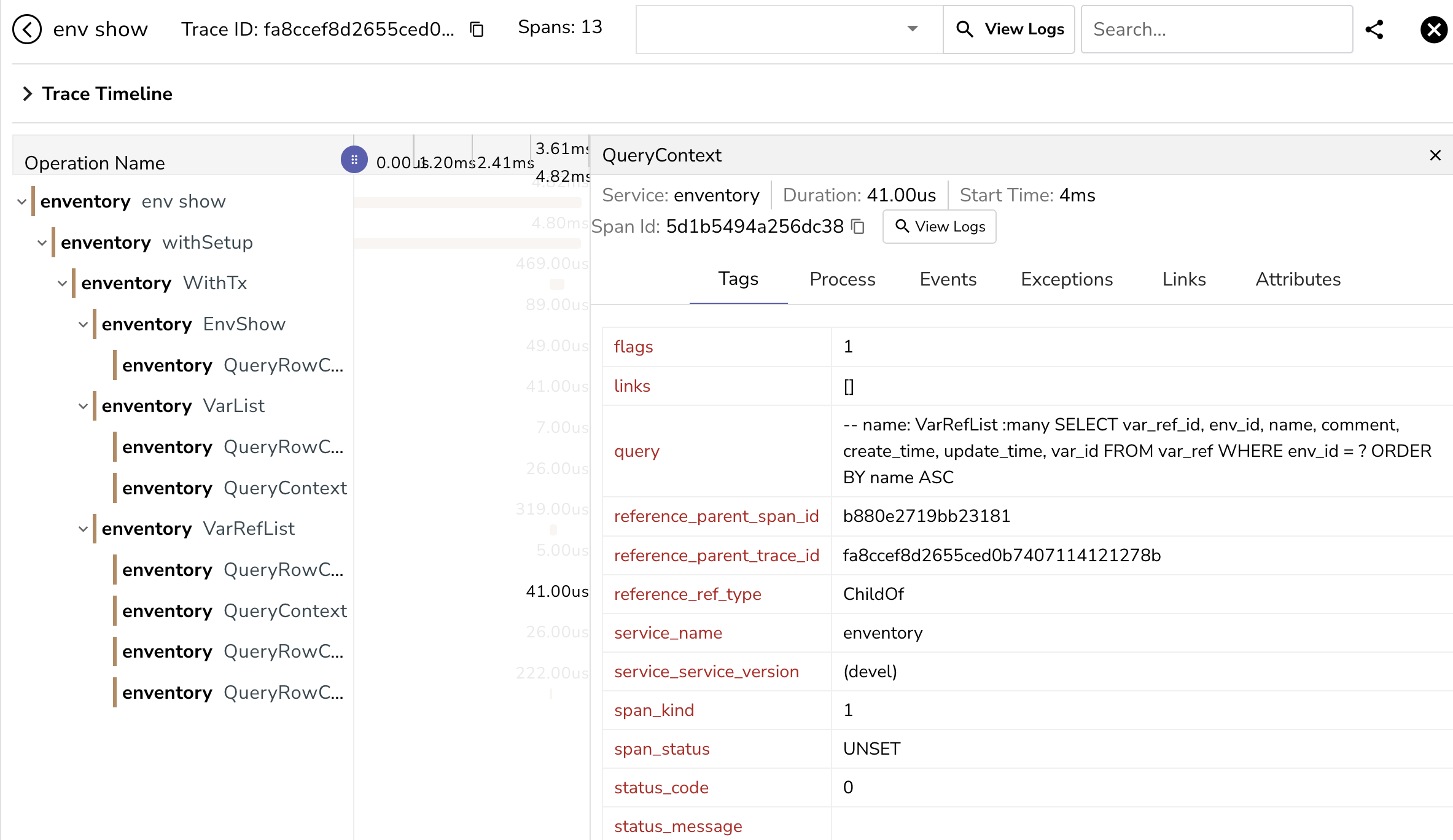
- tree view of calls
- timestamps and span duration
- structured data (for example, the exact SQL query here)
OTEL Trace Implementation
Can do pretty well simply by wrapping the interfaces
func (t *TracedService) EnvCreate(ctx context.Context, args EnvCreateArgs) (*Env, error) {
  ctx, span := t.tracer.Start(
    ctx,
    "EnvCreate",
    trace.WithAttributes(
      attribute.String("args.Name", args.Name),
      attribute.String("args.Comment", args.Comment),
      attribute.String("args.CreateTime", TimeToString(args.CreateTime)),
      attribute.String("args.UpdateTime", TimeToString(args.UpdateTime)),
    ),
  )
  defer span.End()

  env, err := t.Service.EnvCreate(ctx, args)
  if err != nil {
    span.RecordError(err)
    span.SetStatus(codes.Error, err.Error())
  }

  return env, err
}
New commands are tedious
Updates:
- DB schema (sometimes)
- SQL queries
- Generate DB code
- Update
models.Serviceinterface - Update
models.TracedServiceimplementation - Update
app.Serviceimplementation - Update CLI layer
- Update output functions
- Add snapshot tests
AI Agents excel at tedium!
enventory var ref update prompt (and codegen needed to be slightly modified)
--- mode: agent tools: ['codebase'] ---
Add a
var ref updatecommand. It should look like:enventory var ref update \ --comment 'newcomment' \ --confirm true \ --create-time <time> \ --db-path <path> \ --env <env> \ --name myrefid \ --new-env <another env> \ --new-name myrefidnewname \ --ref-env <env> \ --ref-var <ref var name> \ --timeout <timeout> \ --update-time <time>This should be very similar to
var updateorenv updatecommands
- Add a
VarRefUpdatemethod toEnvServiceinmodels/env.gothat calls thesqlcgen.VarRefUpdatemethod- Implement it in
app/var_ref.go- create
VarRefUpdateCmdandvarRefUpdateRunincli/var_ref.go- Add a test in
main_var_ref_test.go
Package with GoReleaser
- Configure YAML file
- Package architecture-specific binaries for:
- GitHub releases
- Homebrew
- Scoop (Windows package manager)
Lint with Golangci-lint
Package individual linters in one binary in pre-commit and CI
- Another YAML file
- check formatting
- check common mistakes
- Currently using 14 linters (easy to add more)
Naming is hard
Went through several names I didn't like or were already taken... (some examples)
| envporium | Envtopia | Enviary | Envana |
|---|---|---|---|
| envisible | enviscerate | envdb | envision |
| switchenv | envosaur | envinity | envvardb |
| envcentral | envdepot | Enviator | Envoke |
| Envsource | Envelope | chenv | envirodb |
Things I didn't learn with enventory
- Queues / Async / dealing with long-running tasks or retries
- Auth
- GUIs
Future Feature Ideas
As time/interest allows...
- Safer migrations (pre-req to most of these)
- backup before migrating
- testing
env ref- just#includean environment instead of reference each var separately- issues with recursive references
- issues preventing duplicate names in one environment
- All of these can be handled at SQL level with some complicated triggers, but haven't gotten annoyed enough yet to implement this
- Search functionality
- easy to add with SQLite, but haven't needed it
- Undo/redo commands
- Inspired by Poor man's bitemporal data system in SQLite and Clojure
- More triggers + backup tables + making sure every operation is undoable/redoable?
- GUI/TUI
Thank you!
Thanks for reading!